Cooperation at Sea: International Digital Standards and Regulations
Dec 2, 2025
Den maritime verden endrer seg raskere enn noen gang. Etter hvert som digitalisering, automatisering og autonomi går fra visjon til virkelighet, sliter rammeverkene som støtter dem med å henge med.
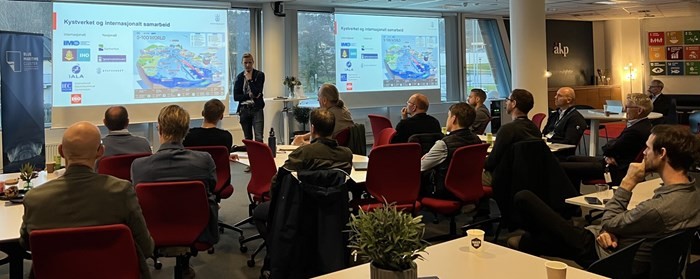
In collaboration with ITS Norway, we brought authorities, technology developers, and industry leaders together to assess where international regulation is heading—and to address the challenges that arise when developing world-class maritime solutions without clear guidelines.
Development of New International Standards and Regulations
The global race toward maritime digitalization is accelerating, and with it the need for clear, future-oriented rules. ITS Norway opened the seminar with an update on the international standardization landscape – focusing on digital standards. Although the global community working on this is relatively small, a clear trend is emerging: major Asian shipbuilding nations are becoming increasingly active, using standardization strategically to strengthen their shipbuilding industries.
From IMO’s work on automation and navigation to the development of the S-100 framework, it is evident that standard-setting is no longer a quiet technical process. It is becoming a strategic arena for competitiveness, market access and industrial positioning.
The Norwegian Maritime Authority highlighted how innovative Norwegian projects are already influencing global rule-making through alternative design processes. Their update included the ongoing development of the new MASS Code— planned to become voluntary from 2026 (which still lacks guidance on Remote Operating Centers), as well as their plans for the guideline RSV 12/2020 for Reduced manning – where it was indicated that the work of a new regulatory framework is now started.
From this discussion, it was highlighted that standardization is not really a barrier, it is a catalyst. When standards provide clarity, consistency and predictability, they enable industry to innovate faster, safer, and with greater confidence.
Experiences from World-Class maritime projects
Several industry and public-sector actors shared experiences from some of the most advanced maritime projects to date.
Vard described the challenges of building some of the world’s most technologically advanced vessels while SOLAS still lacks clear and unified definitions of responsibility for remote and autonomous operations. The question becomes even more complex when vessels are remotely controlled but still carry crew. Some of the pioneering projects developed in the cluster are now pushing the boundaries of how core SOLAS definitions should be understood.
The Norwegian Coastal Administration presented their ongoing work with Kystdatahuset, BarentsWatch, MarU and the implementation of the S-100 standard—critical components for safe and efficient e-navigation. These platforms demonstrate how public authorities can drive digital transformation by establishing shared data structures and open, interoperable services.
HAV Group shared their roadmap toward autonomous operations on the Lavik–Oppedal ferry route, with a target of autonomy in 2028. While they are developing multiple autonomy platforms, safety architectures and integration layers, it’s evident that innovation is being constrained when standards lag behind technological progress. On the other hand, these projects are also key examples of how collaboration between the companies of the cluster drives innovation forward on a global scale.
How standardization can shape the maritime world
Another highlight of the seminar was Open Studio’s presentation on the global uptake of Open Bridge—a Norwegian-born initiative that is rapidly becoming a success story for modern maritime standardization.
Open Bridge is now entering a commercial phase. What began as a national project has grown into an international reference point, with more than 80 percent of its users located outside Norway. This demonstrates how open, shared standards can scale globally when they address real operational challenges. The market is responding accordingly: an increasing number of tenders now require Open Bridge compatibility, and companies have started to actively seek candidates with Open Bridge experience.
This evolution illustrates how standardization can act as a genuine engine of innovation.
What role should we take?
Throughout the seminar, there was one underlying question
What role should Norway play in shaping global standards and digital maritime regulations?
Several conclusions became clear:
We must be present and active in international working groups—because others are.
Our pioneering projects (from advanced offshore vessels to autonomous ferries) give us unique insight that can benefit global rule development.
Closer coordination between industry and authorities is essential if we are to influence processes effectively.
Standards are now a strategic tool for competitiveness, not just a compliance exercise.
By shaping standards, we shape markets—including those where Norwegian technology already leads
If the Norwegian maritime cluster wants to maintain its position as a world leader in maritime innovation, we must ensure our experiences, solutions, and values are reflected in future regulations.