Blue mussels as a future feed ingredient: Insights and opportunities from the BlueMusselFeed project
Nov 19, 2025
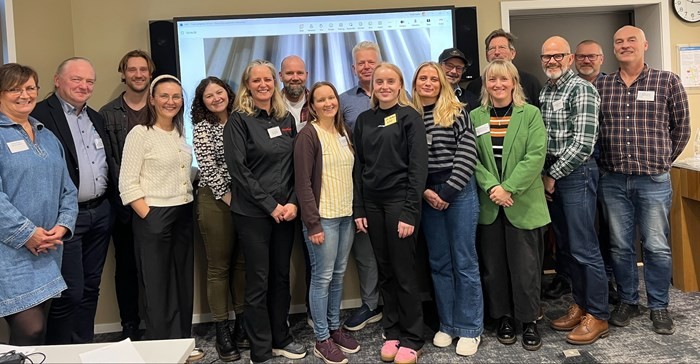
On Wednesday, November 12th, researchers, industry, and businesses gathered at Gardermoen for the final seminar of the BlueMusselFeed project – a research project funded by the Research Council of Norway, which explores mussels as a sustainable protein source in the Norwegian feed industry.
Collaboration Across Blue and Green Sectors
The BlueMusselFeed project has examined the entire value chain – from cultivation and processing to testing in feed and evaluation of meat quality – with the aim of making blue mussels a commercial feed ingredient for chicken and potentially other livestock. Developing new animal feed requires a team of experts from very different industries and fields. Therefore, BlueMusselFeed has brought together experts in aquaculture (Ocean Forrest, Eide) and feed (Fiskå), alongside chicken producers (Nortura) and experts in animal welfare, food safety, and meat quality (Animalia, NMBU).
Project Summary
Project leader Hilde Schøyen from Fiskå Mølle highlighted the significance of the results and what they could mean for the Norwegian feed industry:
"Mussel protein qualifies as a new, Norwegian feed commodity with very high protein content and high biological value for both livestock and farmed fish. Mussels as a basis for the establishment of large-scale industry can unify many links in our food system, and mussels are an organism that the blue and green sectors can collaborate on. This project was just the first step, and I hope many more initiatives on mussels will follow!"
The findings from the project showed that blue mussels have the potential to be a new, Norwegian feed ingredient – with high digestibility, good protein quality, and no negative impact on animal welfare or meat quality. Fernanda Tahamthani (Animalia) was pleased with the learning outcomes from the project:
"It has been an exciting project where we have learned a lot, and it has been a steep learning curve. I am looking forward to the future use of mussels."

Fernanda Tahamthani from Animalia.
This was also supported by Miriam Donovan from Lerøy Ocean Forest, who drew connections between the project’s results and the need for further development:
"We have documented that blue mussels can be a promising feed ingredient for chicken, and we have gained valuable knowledge along the way. At the same time, we see that there is still much work to be done. In light of the societal mission for sustainable feed, I believe that mussels are an obvious resource we must start to utilize. Therefore, I hope we can build on this effort in new projects, so we do not let this opportunity go to waste!"
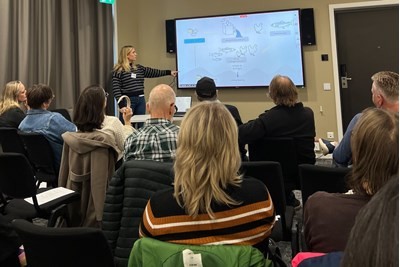
Miriam Donovan from Lerøy Ocean Forest.
The project also points to challenges that must be addressed before commercialization, such as processing, storage stability, salt content, and the need for scaling up production. However, the limitations did not dampen the enthusiasm to continue working:
"This is just the beginning, and it will be very exciting to see the continuation," says Fernanda.
Several also emphasized how crucial it will be to build a sustainable and profitable value chain around mussels.
"With its high protein yield, mussels can be part of the future's raw materials for livestock and farmed fish. To succeed with this, I want to highlight the importance of involving the entire value chain, especially already established players in the primary sector. To realize a scaling up, there should be added value in addition to the feed ingredient. Either parts of the volume must be sold at a higher value, or generate income in other ways, for example through payment for ecosystem services," said Sigurd Madsen who had an internship in BlueMusselFeed as part of his master's in bioeconomy at NMBU.
Putting Mussels on the Agenda
The discussions throughout the day were marked by engagement, curiosity, and clear belief in further development. Alexander from Bellona was also clear in his opinion about the importance of projects like BlueMusselFeed:
"The food system accounts for about 33% of greenhouse gas emissions and 80% of deforestation – this is a structural climate crisis we can no longer ignore. We need policies that mobilize innovation, scalable production, and sustainable raw materials. Projects like BlueMusselFeed can become part of the solution. Going forward, we must radically reassess what we feed our food with; raw materials like mussels have documented potential to deliver on both the societal mission for sustainable feed and on production that provides important ecosystem services to the marine environment."

Alexander Ugland from Bellona.
Here, Lise Lotte Dalen from NCE Heidner Biocluster also pointed out the broader bioeconomy perspective:
"Mussels can be part of several value chains because they can both be eaten by humans and used as feed in agriculture and aquaculture. This makes mussels an example of a raw material that can build a robust value chain, precisely because it creates value in several industries at the same time".
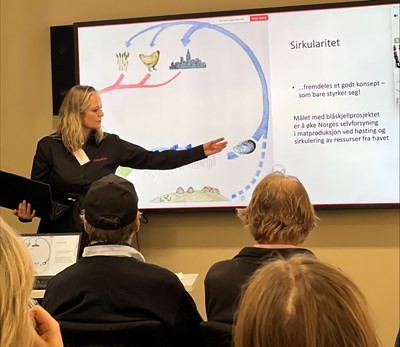
Hilde Schøyen from Fiskå Mølle.
She continues:
"Low-trophic organisms in the sea, such as mussels, can also provide important ecosystem services which we know have great value – even though it is still challenging to quantify this value. Failing to make visible and value such contributions can have significant consequences for both the natural resources and food production".
Commitment for the Way Forward
Several participants emphasized the importance of collaboration, land efficiency, and storytelling to elevate low-trophic species into the feed market – both as part of Norwegian preparedness and a step towards more sustainable food systems.
"A major political challenge is land access; if mussels are to become a key component of future feed, clear public frameworks, investments in technology, and regulations that reflect that production contributes to alleviating environmental pressure along our coast are required. Norway must move from words to action and use its political leeway to elevate this from niche to national industry," said Ugland.
The atmosphere at the seminar was optimistic and forward-looking, and it was clear that BlueMusselFeed has sparked a spark for further collaboration between research, industry, and governance.